
Installation Guide

How to Install the
Slimline 50 with Fixed Arms

Suitable for builders, awning contractors and confident DIY installers

The Slimline 50 with Fixed Arms has arms welded directly onto the frame at either end — no separate brackets, no assembly. Pick up the whole awning and screw it straight to the wall through the arms into the studs. Silicon seal the back and you are done. The simplest awning to install we make.

You'll need: Spirit level Tape measure Stud finder Drill & bits Structural screws Silicone gun
The arms must fix into timber studs behind the cladding — structural screws only. Never fix into cladding alone.
step01

Understanding the Slimline 50 with Fixed Arms system
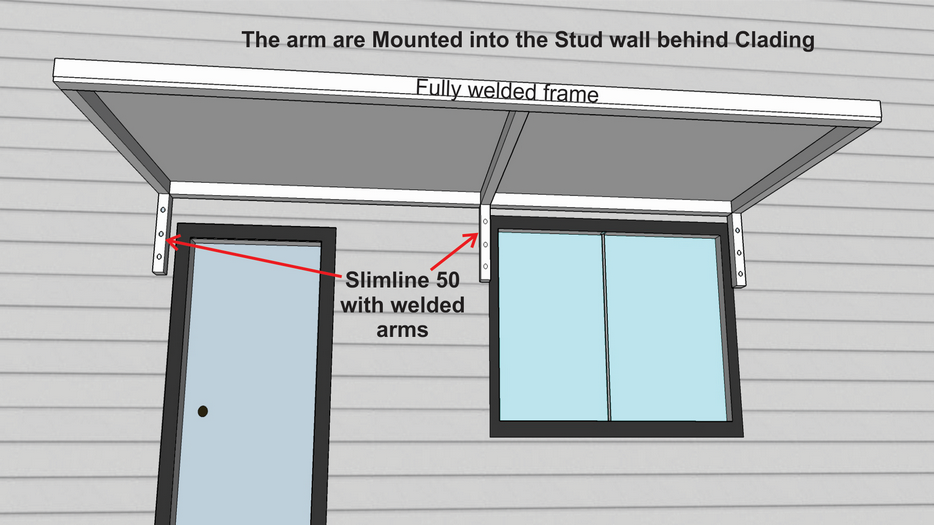
Slimline 50 with Fixed Arms installed over door and window on cladded wall
The Slimline 50 with Fixed Arms installed over a door and window — arms welded to the frame, fixed directly into the studwork behind the cladding

The Slimline 50 with Fixed Arms is a fully welded awning where the arms are part of the frame — not separate components. The arms run down the sides of the awning and fix directly into the timber stud wall behind your cladding.

Because the arms are welded on at fixed positions, you need to know exactly where your studs are before you order — the awning is custom made to suit your stud positions. This makes it ideal for:

  • Installations over windows or doors where the arms naturally land on the king studs on each side of the opening.
  • Situations where you know exactly where structural timbers are and can confirm their positions before manufacture.
  • Wide awnings over 3 metres — a centre arm can be added if there is a structural timber at that position.
Confirm all stud positions with a stud finder before ordering. The arm positions are set at the manufacturing stage and cannot be adjusted on site.
step02

Locating your studs and understanding the wall structure
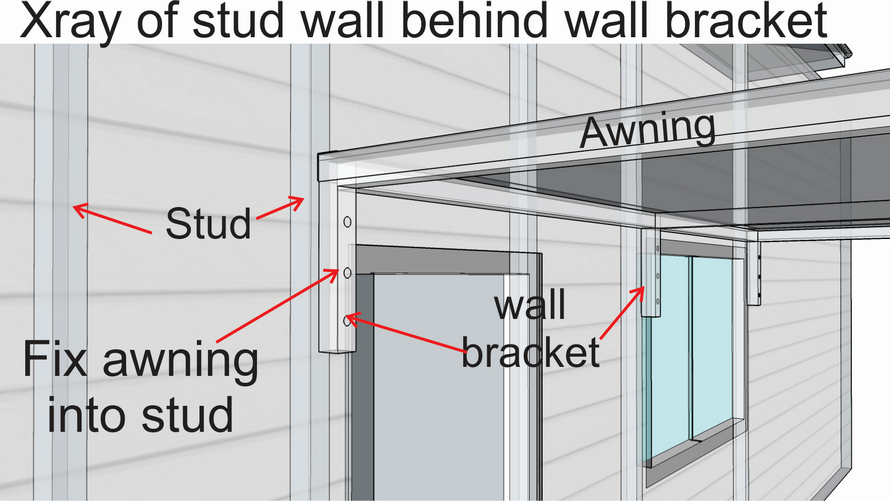
X-ray view showing studs behind cladding wall and wall bracket fixing position
X-ray view — the wall bracket fixes through the cladding and directly into the timber stud behind it

First, before doing anything, locate every stud position on your wall where an arm will fix. Use an electronic stud finder and mark each stud clearly with a pencil.

  • For a standard 2 arm awning — you need a stud at the left arm position and a stud at the right arm position.
  • For a 3 arm awning over 3 metres — you need an additional stud or structural timber at the centre arm position as well.

The most common installation is over a window or door opening — the king studs on each side of the opening are almost always in exactly the right place for the arms to fix into.

⚠ Never fix a structural awning arm into cladding alone — always into the timber stud or structural member behind it. If you are unsure, consult a builder before ordering. Take photos of your stud finder readings and share them with us when ordering — this helps us confirm the arm positions are correct before manufacture.
step03

How to mark the wall before fixing

Next, before lifting the awning into position, mark the wall clearly so you know exactly where it is going.

  • Mark the height of the top of the awning on the wall at each arm position.
  • Use a spirit level to draw a level line across the wall connecting all arm positions — this is your reference line for mounting height.
  • Mark the centre position of each stud clearly.
Getting the level line right before lifting the awning is the most important step — it is much easier to adjust a pencil line than an awning that is already up. Pre-drill pilot holes through the cladding at each arm fixing position before lifting the awning. This makes driving structural screws much faster once the awning is held in position.
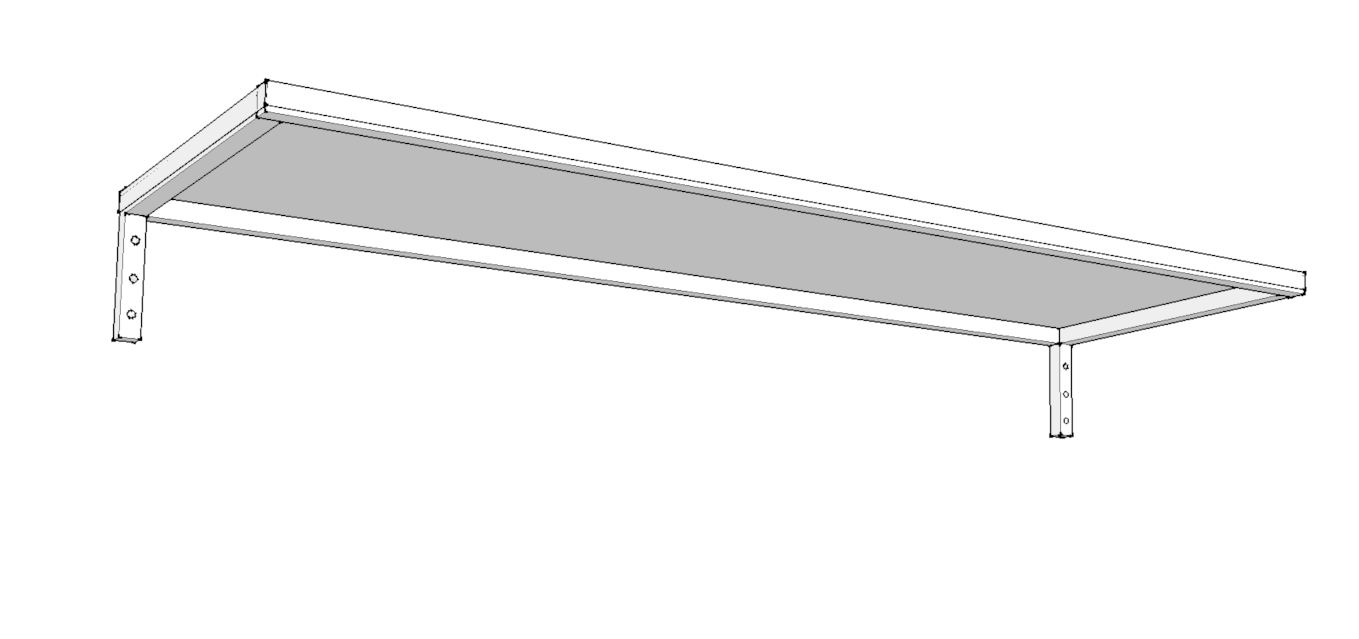
Slimline 50 with Fixed Arms diagram showing 2 arm configuration
2 arm configuration — one arm at each end of the frame, welded permanently to the awning
step04

How to fix the awning to the wall

This is the step that makes the Slimline 50 with Fixed Arms so straightforward — the entire awning goes up in one lift.

  • Lift the awning into position with the arms flat against the wall, aligning the arm fixing holes with your pre-drilled pilot holes.
  • Hold the awning level — use a spirit level across the front frame or have a second person check level while you drive the first screws.
  • Drive structural screws through the fixing holes in each arm and into the stud behind the cladding — do not fully tighten until all screws are started.
  • Once all screws are in and the awning is confirmed level, tighten all screws fully.
Two people makes this step significantly easier — one to hold the awning level, one to drive the screws. For wider awnings over 2 metres, two people are strongly recommended. ⚠ Check level before tightening fully. An awning that is slightly out of level is very difficult to adjust once all screws are tight.
step05

How to seal the awning to the wall

Finally, with the awning fixed to the wall, the last step is to apply a continuous bead of silicone along the joint between the rear rail and the wall surface.

Angle the nozzle so the silicone is forced into the gap between the rear rail and the wall rather than sitting on the surface. Silicone performs best when bonded between two surfaces under slight compression.

  • Use exterior-grade silicone.
  • Apply in one continuous bead with no gaps.
  • Tool smooth with a wet finger or silicone tool.
  • Allow to fully cure before exposure to rain.
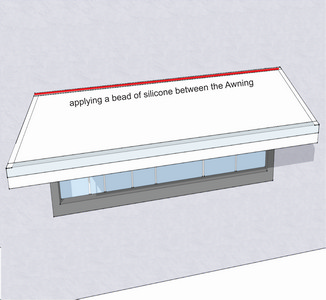
✓ Installation complete. Your Slimline 50 with Fixed Arms is ready.
Sealing between Slimline 50 with Fixed Arms rear rail and wall with silicone
Angle the nozzle into the joint — silicone forced between rear rail and wall
The arms are welded onto the awning frame during manufacture at fixed positions. Unlike the Cantilever Arms model where arms can be positioned anywhere, the Slimline 50 arm positions are set at the factory. You need to confirm stud positions first so we can make the awning to suit your wall exactly.
Use an electronic stud finder — available at any hardware store. Run it across the wall and it will beep or light up when it detects a stud. For most cladded homes in Australia, studs are spaced at 450mm or 600mm centres. The king studs on either side of a window or door frame are almost always a reliable fixing point.
Yes. On a brick or masonry wall the arms fix using masonry bolts rather than structural screws. Because the arm positions are fixed, confirm your desired arm positions with us before ordering and we will ensure the fixing hole layout suits your wall.
For awnings over 3 metres wide a centre arm is generally required. This is confirmed during the design stage before manufacture. For the centre arm to be included, there must be a structural timber — stud, noggin or LVL — at the centre position on your wall. Let us know your wall structure when ordering and we will advise.
If your studs do not line up with the arm positions required for your awning width, the Slimline 50 with Cantilever Arms may be a better option — the cantilever arms are independent of the frame and can be positioned anywhere to suit your studs. Give us a call and we will help you find the best solution.
You do not need to be a tradesperson. The Slimline 50 with Fixed Arms is one of the simplest awnings to install — the whole awning goes up in one lift and is screwed straight to the wall. If you are comfortable using a drill and a spirit level and you know where your studs are, the installation is very straightforward. Two people makes it significantly easier.
Use an exterior-grade silicone designed for outdoor use. Any silicone rated for sealing gutters and roofing will be suitable for sealing an awning to a wall.
Small gaps between the rear rail and the wall can be filled with silicone once the awning is fixed. For larger gaps, timber or aluminium packers can be placed behind the arms before fixing to bring the awning out level. We recommend discussing uneven walls with us before ordering.

Custom-made in Sydney — supply your measurements and stud positions and we'll build it ready to fix.

Get a Quote or call 0405 533 839 Back to Slimline 50 with Fixed Arms