
How to Install the
Slimline 50 with Cantilever Arms
Suitable for builders, awning contractors and confident DIY installers
The Slimline 50 with Cantilever Arms is purpose-built for cladded walls. The arms fix directly into the timber studwork behind the cladding — mount the brackets to the wall first, then drop the awning panel over the top. Clean, strong and very straightforward to install.
Understanding the cantilever arm system
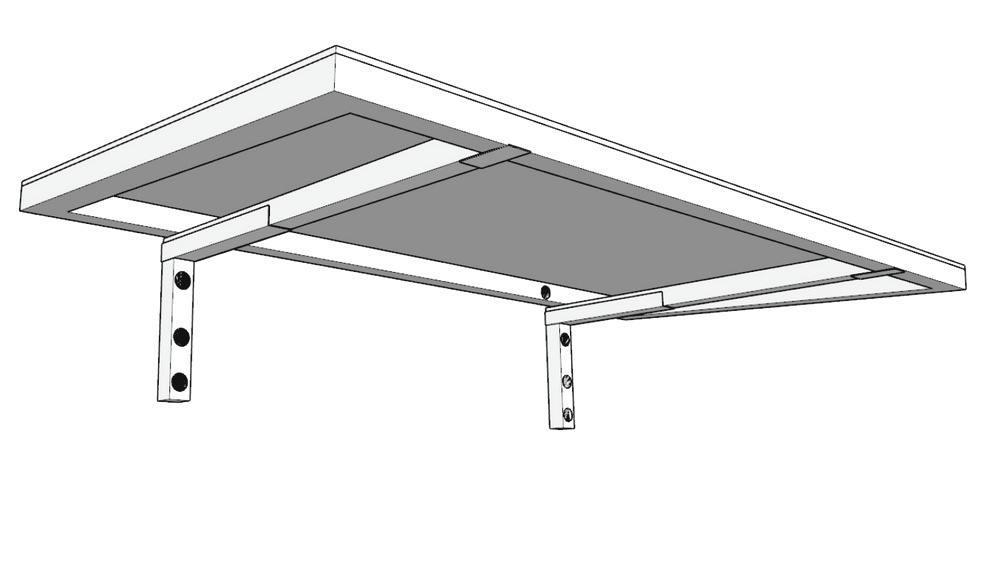
The Slimline 50 with Cantilever Arms is specifically designed for cladded walls where you need to mount the arms into the studwork behind the cladding. The brackets are mounted onto the wall first, and then the awning simply drops over the top of the arms — very simple and straightforward to install.
The arms are completely independent of the awning frame, which means they can be positioned anywhere along the wall to line up with the timber studs behind the cladding. No fixed bracket spacing — position them exactly where the wall structure is strongest.
Before starting, locate all timber studs behind your cladding and mark their positions clearly. All arm positions must align with a stud.Understanding the cantilever arm parts
The wall bracket
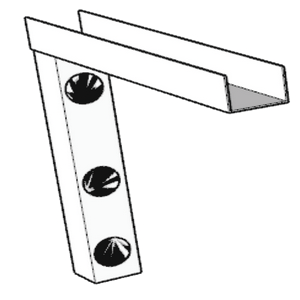
The wall bracket is the component that fixes directly to the wall. It is made from heavy-duty powder-coated aluminium with fixing holes for structural screws or masonry bolts depending on your wall type.
The bracket has a U-channel at the top — this is where the arm slots in and is secured with Tek screws.
The cantilever arm
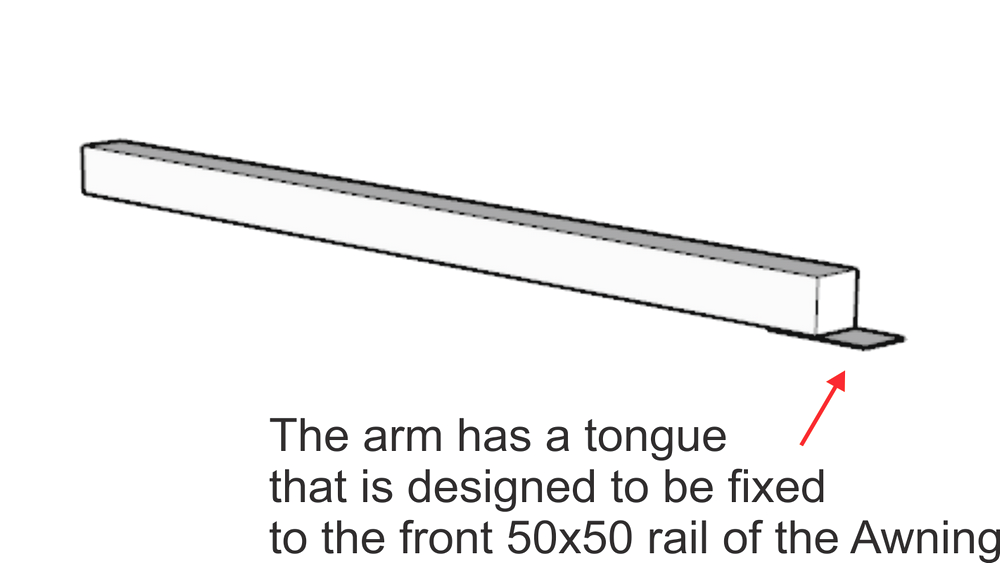
The arm is a 50×50mm aluminium section that projects outward from the wall bracket. The tongue identifies which end is which:
- Front end — the tongue is at the front on the low side of the arm. It seats into the front rail of the awning panel and is fixed with a Tek screw.
- Rear end — the opposite end to the tongue. This end slots into the U-channel of the wall bracket.
How to assemble the cantilever arms
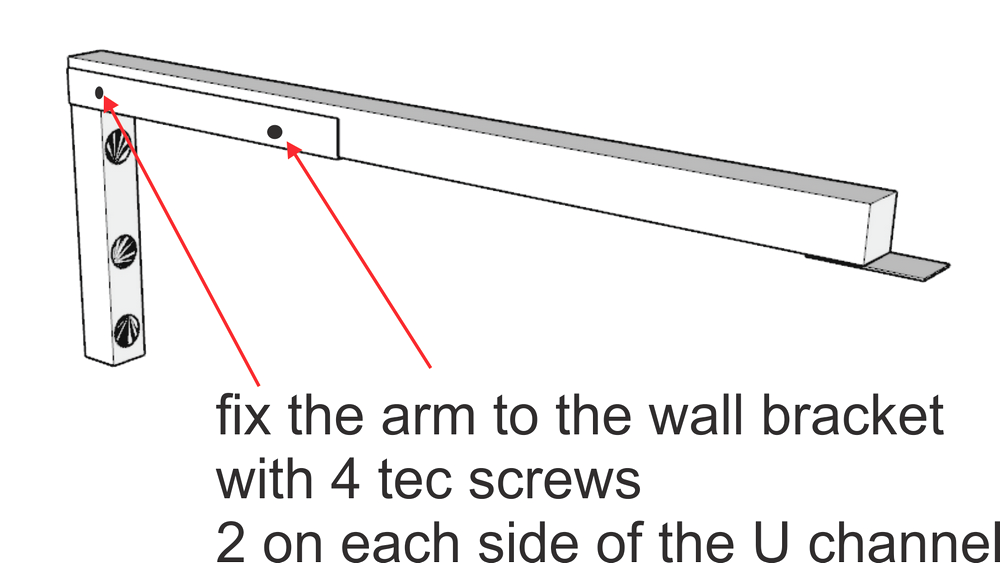
Assemble each arm to its wall bracket on the ground before fixing anything to the wall — it is much easier than trying to do it once the bracket is on the wall.
- Slide the rear end of the arm into the U-channel of the wall bracket.
- Align the arm so it sits square in the channel.
- Drive 4 Tek screws — 2 on each side of the U-channel — through the channel wall and into the arm to lock it firmly in place.
How to fix the cantilever arms to the wall
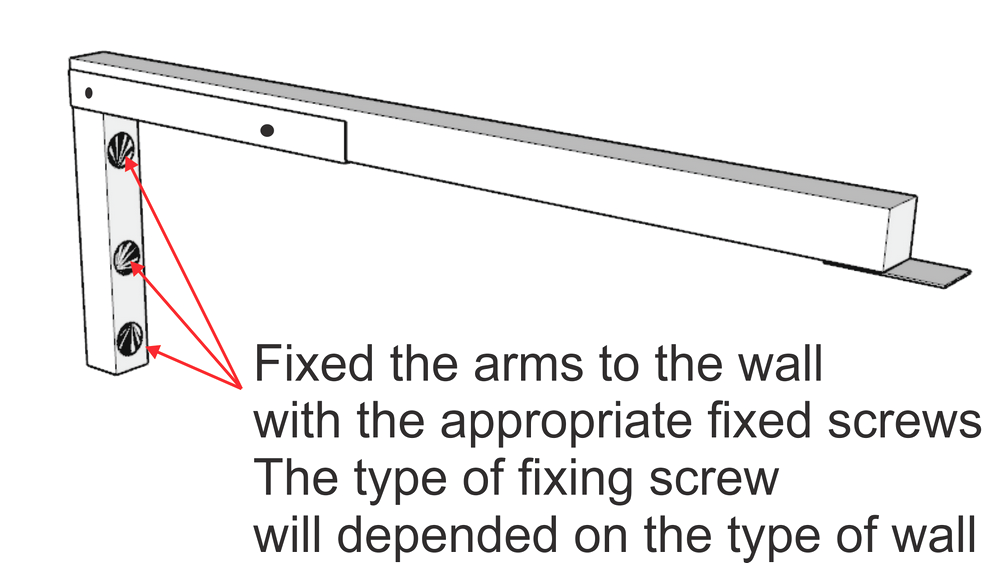
Mark the position of each arm on the wall. Use a spirit level and a straight line to confirm all arms will be at exactly the same height — this is critical for the awning panel to sit flat.
- Hold the assembled arm against the wall at the marked position.
- Fix through the wall bracket using structural screws into the timber studs behind the cladding.
- Check level after fixing before final tightening.
The arms can be positioned anywhere under the awning frame — they are not fixed to a set spacing. Position them to suit the stud locations on your wall.
- As a minimum, one arm should be within 200mm of each end of the awning frame.
- Always position arms directly over a stud — never fix into cladding only.
- The number of arms required will have been confirmed during the design stage.
How to mount the awning panel onto the arms
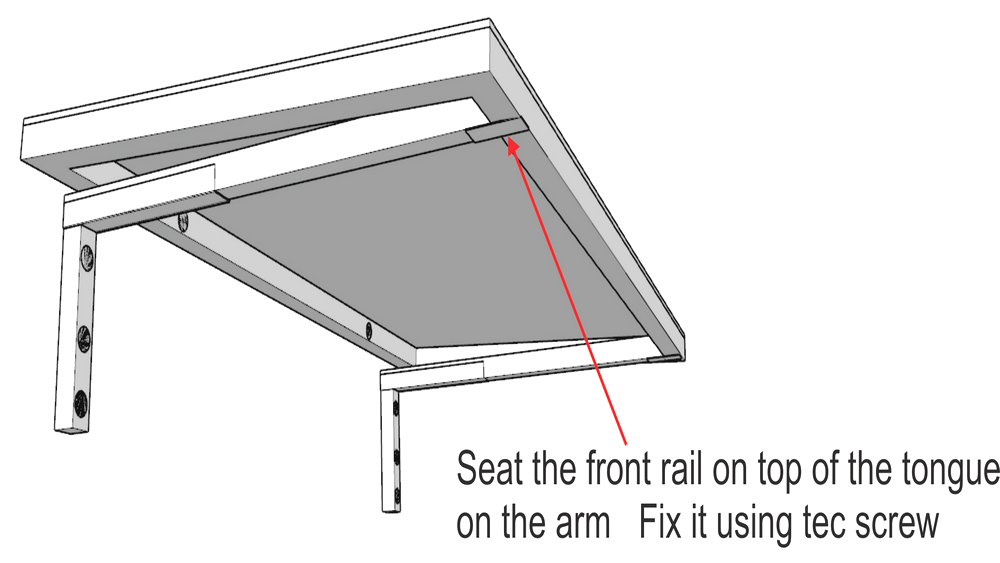
Lift the awning panel and position it so the front rail seats onto the tongue at the front of each cantilever arm, with the rear of the panel resting against the wall.
- Make sure the front rail is fully seated onto every arm tongue before driving any screws.
- Once seated and sitting flat, drive a Tek screw through the front rail into each arm tongue to lock the front of the panel in place.
How to fix the rear rail to the wall
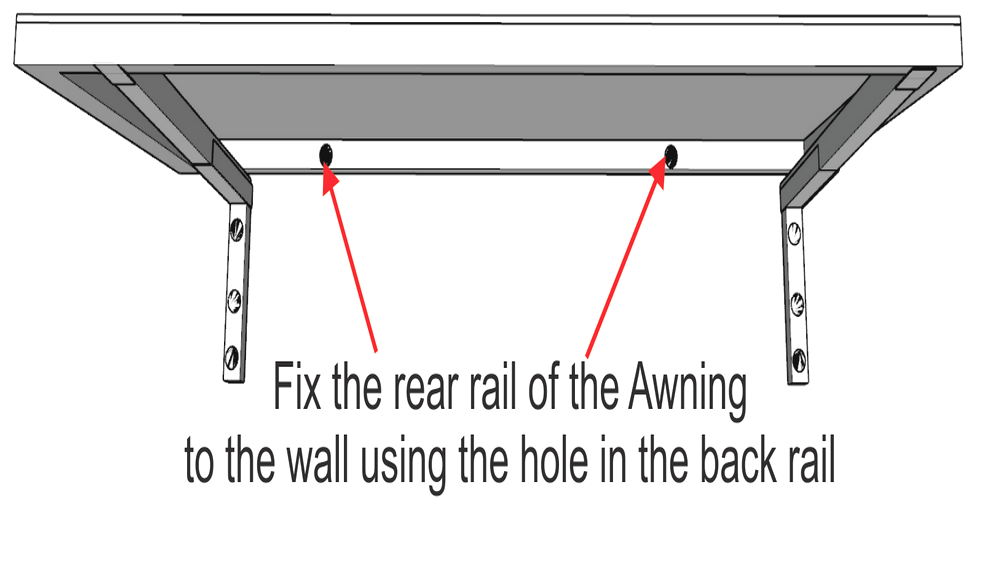
The rear rail has pre-drilled fixing holes. Use these to mark the wall, then drill and plug the holes before fixing the rear rail firmly to the wall.
- Mark through the holes in the rear rail onto the wall surface with a pencil.
- Remove the panel, drill the marked holes and insert the appropriate wall plugs or fixings.
- Reposition the panel and fix the rear rail to the wall through the pre-drilled holes.
How to seal the awning to the wall
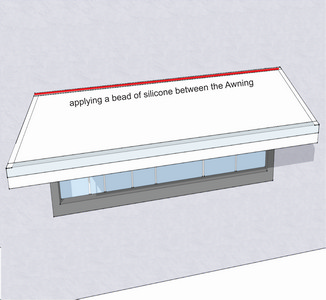
Finish the installation by applying a continuous bead of silicone along the joint between the rear rail and the wall surface.
Angle the nozzle so the silicone is forced into the gap between the rear rail and the wall. Silicone performs best when bonded between two surfaces under slight compression.
- Use exterior-grade silicone.
- Apply in one continuous bead with no gaps.
- Tool smooth with a wet finger or silicone tool.
- Allow to fully cure before exposure to rain.
Custom-made in Sydney — supply your measurements and we'll build it ready to fit.
Get a Quote or call 0405 533 839 Back to Slimline 50 with Cantilever Arms